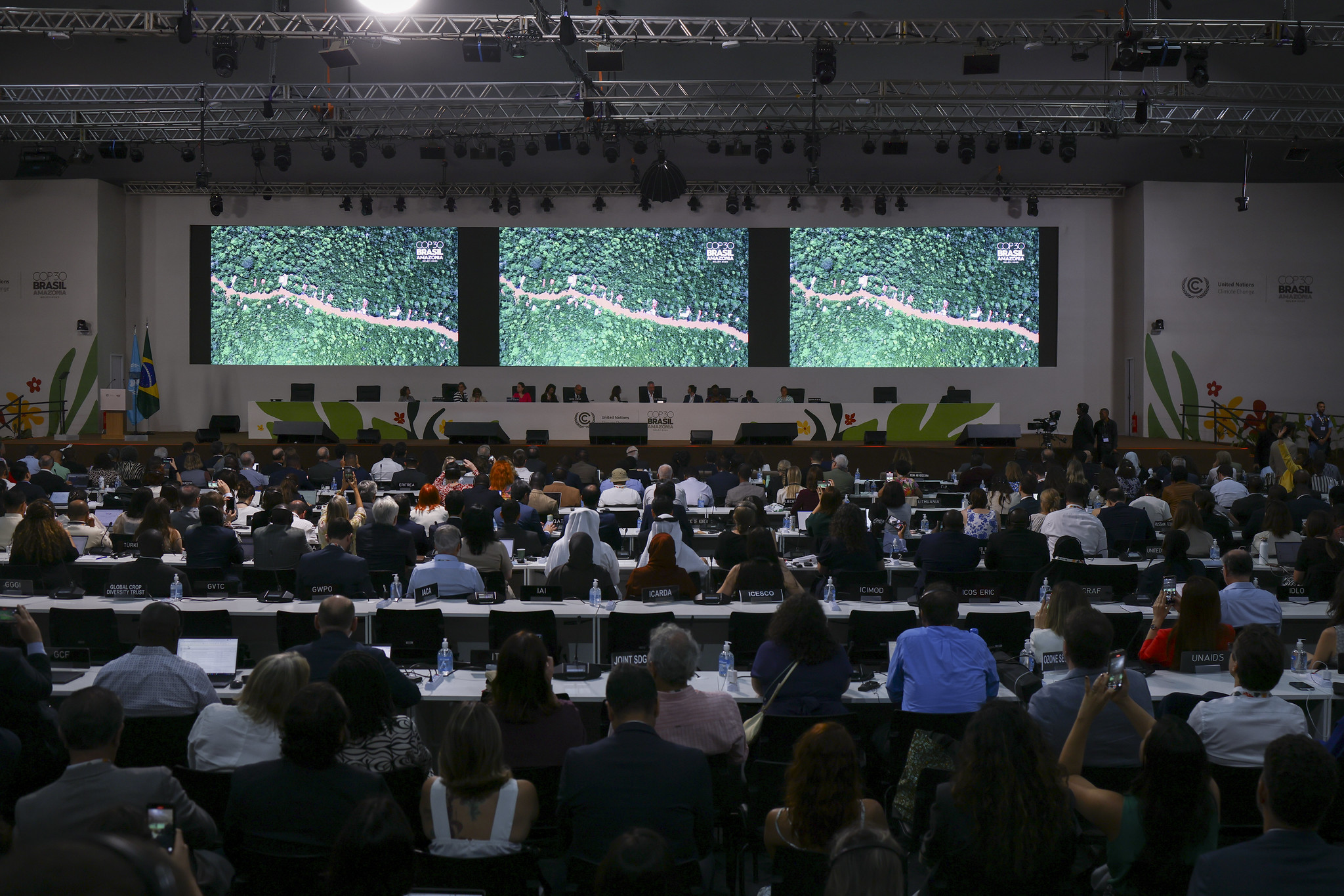
The ENTICE project teamed up with the Green Trade Network (GTN) to co-host an expert webinar on 16 December 2025, examining the evolving relationship between trade and climate policy in the aftermath of COP30, held in Belém, Brazil. The discussion brought together leading voices from policy, research, and practice to reflect on recent developments at the trade–climate nexus, assess their implications for global climate governance, and explore what they mean for future cooperation on trade and climate. The webinar marked the first event in ENTICE’s series of online seminars, organised as part of the project’s transdisciplinary listening mechanism, which aims to encourage mutual learning between researchers and stakeholders.
The webinar was opened by Pierre Leturcq (IEEP), who welcomed participants on behalf of GTN. Lukas Hermwille (Wuppertal Institute / ENTICE) then introduced the objectives of the ENTICE project, highlighting its focus on improving understanding of the trade–climate–industry nexus and the impacts of trade and trade policies on climate action. Maro Baka (E3-Modelling) complemented this introduction by outlining ENTICE’s research approach, including its emphasis on improved modelling, data transparency, and stakeholder engagement.
The keynote address by Michael Mehling (MIT) focused on the growing integration of trade and climate agendas. He highlighted COP30 as a milestone, marking the first time trade was explicitly referenced in a UNFCCC outcome. Key developments included the launch of a new UNFCCC Climate–Trade Dialogue and the establishment of the Integrated Forum on Climate Change and Trade (IFCCT) under the Brazilian presidency.
The panel discussion brought together Ieva Baršauskaitė (IISD), Ellie Belton (E3G), Markus Gehring, and Carolyn Deere Birkbeck (TESS). Speakers discussed the EU’s role in shaping trade-related climate measures, the increasing engagement of developing countries, legal and equity considerations, and the growing number of international platforms addressing trade and climate.
The session was moderated by Lukas Hermwille and Pierre Leturcq and concluded with reflections on both the opportunities and challenges ahead, particularly the need to coordinate across multiple initiatives while maintaining political momentum.
More information is available in the seminar summary document here.
You can watch the webinar recording here.